The Passion and Redemption of a Proletarian Seer
It’s barely been ten days but this is different. I wrote the following piece on M.H.R., as I like to call him, many months ago. And, even though I’ve sent it out to a range of outlets, no one wants to publish it. So (partly to test the possibility of using this newsletter as a very occasional substack as well) I’m sharing it directly with you—on the 74th anniversary of the July Revolution of 1952. In the light of the film that was made about him, M.H.R. feels not only significant but also endlessly fascinating. Here now, as they say, what I have to say about him just might be worth someone’s time.
Born Again
When he heard the voice, as he tells it, M made tea. He thought it was a female djinn, but he was not scared. They would have tea and make conversation. Maybe they would make love. M doesn’t say this but it’s implied. The voice must’ve been seductive; that too is implied. It penetrated the wall of the rooftop laundry room where he lived; “penetrated” is the word he uses. But it wasn’t a djinn, male or female. He doesn’t say what it was. It told him to go to Sayeda Zeinab, the famous shrine mosque at the other end of Cairo.
The way M tells it, it’s as if he got a phone call from a friend inviting him to a glass of tea. But, until he mentions God, almost as an afterthought, it’s not clear who invited him to what. It must’ve been night when he got to the mosque. The lights, he says, were dazzling. Once he was inside the voice returned. It said, Ha’gebak! The word is Egyptian Arabic for “You’ll like me,” but it means something like “At your service.” It’s not clear what it means. M says it messed him up to hear it. Suddenly he was bent over. The technical term is kyphosis, but this would be instant, temporary kyphosis. M’s back curved so much he had to walk on all fours. Holy men gave him food.
Then, in a trance, he was crawling out of the mosque and the whole neighborhood. He crawled all the way to Masr Station, at least an hour’s walk, where he could catch a train home to Alexandria. From what you can make of the incomplete, contradictory chronology of M’s life, this wouldn’t be his final return to his hometown; for a few more years he continued to live in Cairo. But it was decisive. Once in Masr Station, he says, he could finally stand up straight. The voice kept at him: Ha’gebak! M had never been religious in his life but by the time he got off the train he was a true believer.
Writing Prompts
When do we lose the drive to keep going?
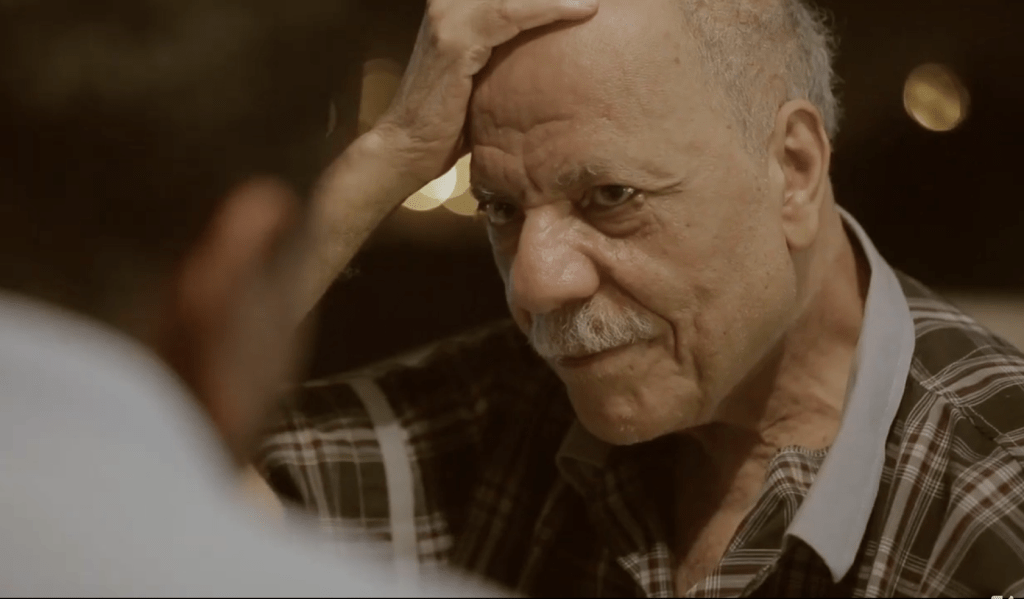
You have several possible focal points for this assignment. First, of course, the hero of the story: the experimental short story writer Mohamed Hafez Ragab (1935-2021), often described hyperbolically as the Reinventor of the Arabic Short Story; M for short. You could also focus on the 2023 documentary about him, The Tedious Tour of M—named for a 1998 selection of his stories: Portions of the Tedious Tour of M. Hend Bakr (b. 1980) started visiting him at his house with the idea to make the film in 2011.
That was the year M’s complete works came out, two volumes of stories, though he hadn’t written a word for some four decades. Until Hend took the film on the festival circuit, not many people paid attention to him anyway.
First, though, the unexpectedly literate street vendor M was at fifteen: rebellious, ambitious—a leader. He had dropped out of school after sixth grade, but he’d been reading since age eight. Now he founded the League of Young Intellectuals from the Provinces, a kind of working-class authors’ guild. His stories were fresh, inventive; the Cairo literati had never read anything like them. He’d send them out to magazines signed “The Peanut and Watermelon Seed Seller from Raml Station.”
You could explore the sixties generation, the way it embraced this uneducated character from downtown Alexandria: the first literary cohort to include working-class writers. Unlike the vast majority of them, M will quickly renounce the secular, leftist zeitgeist of the day and turn to religion. In this he mirrored the movement of society itself: secular and progressive under Gamal Abdel Nasser in the sixties, then more religious than it had ever been from the time of Nasser’s deputy and successor Anwar Sadat on. It was as though society, having stepped into the unknown and ended up disillusioned—notably with Egypt’s disastrous defeat in the 1967 war with Israel—cowered back to an extreme version of what it had always known.
So, too, with M. You could discuss the intersection of psychosis and religious experience, how both inform the creative impulse, forging a literary sensibility. But, first, M’s journey from his “provincial” hometown to the Hub of All Things Culture.
Raise Your Head, Brother!
By 1954, the popular coup d’etat Nasser staged in 1952 had turned an occupied kingdom into a revolutionary dictatorship. It aimed to redress historical wrongs. In this context Italians, Greeks, and especially Jews would be pushed out of the country. Together with liberal attitudes, they were remnants of imperialism; the Jews had occupied Palestine, to boot. Some argue that, from then on, even Egypt’s own Coptic Christians would be marginalized and excluded from power far more systematically than before the fifties.
In this brave new world the children of the fellahin would be able to go to college, becoming ministers and party members. At least the children of military men would. Presumably for the benefit of those same children, the ruthless arms of a centralized state would quickly extend to every inch of the body politic. Political detention would be normalized. Everything would become state property. Even the capacity to produce art and discourse—or be celebrated for it.
By the time the last British troops left in 1956, confined to a newly created establishment, culture was already reducing to an olympics of bureaucratic politicking. If he could succeed at the games, if he could show gratitude to his sponsors, a Muslim fellahin street vendor who’d never made it to high school but was being published in magazines named “Story” and “Culture” had a huge head start.
The Gymnasium
That year, the year Nasser nationalized the Suez Canal, something called the Supreme Council for the Patronage of Arts and Letters came into being. It was the initiative of an officer by the name of Yusuf Sibai, and he was put in charge of it. That was before the establishment of the Ministry of Culture and Nationalist Instruction—it really was called that, yes—headed by a slightly younger officer who, like Sibai, was a close friend of Nasser’s, Tharwat Okasha. Sibai was a prolific writer of mawkish, pedagogic novels. After he became minister of culture in his turn—much later, when Anwar Sadat made peace with Israel—Palestinian militants would assassinate Sibai in Cyprus. For now he was demonstrating his skill as an impresario. He managed the networks of upward mobility and discourse regulation that would scaffold the grand spectacle of culture for the people.
Inheriting the Earth
That’s how Yusuf Sibai appointed him a secretary in the Narrative Commission of the Supreme Council for the Patronage of Arts and Letters. But when Sibai asked him how much he needed by way of a monthly salary, M regrets agreeing to an insufficient sum. Soon, money would be the least of his problems, though.
M doesn’t tell Hend how quickly and how well he antagonized the Council members, or that he published stories openly attacking and making fun of them. He doesn’t mention the sit-in he staged under a tree in the Council’s garden after he was demoted to the archives, reciting the call to prayer when it was time.
That didn’t just result in a stint at the state asylum. It was career suicide. At the time, nothing spelled an irreversible break with the intellectual community more definitively than such a “reactionary” display of religious piety in their midst. Then again, M was so disillusioned with how his Cairo sojourn had turned out it didn’t matter. He was tired and miserable. He was scared.
Literary History
I’m not sure exactly when “intellectual” turned into a job title. To be granted it you had to serve in a kind of corps where rank and loyalty remained paramount. To be admitted into that corps, nothing mattered more than being a so called leftist. This could mean any number of declared positions. But what it meant in practice was Nasser’s jingoistic jumble of ideologies: socialist, decolonial, Arab nationalist. The reward or punishment that came of supporting or opposing it, but always from the same—“patriotic”—perspective.
Apart from each other and sometimes the secret police, M’s generation never had any readers. The remarkable thing is—they didn’t care. No matter how you look at it, in practice, the last thing sixties writers cared about was being read. No matter how talented or inventive they could be, people like Yahya Taher Abdullah and Abdel Hakim Qasem wrote in counterintuitive registers of formal Arabic. At their best they were subtly lyrical, but even then their work comes across as deliberately abstruse. It isn’t always clear what they are even writing about. Their work went unedited and—outside of their critics’ even less readable, pseudo-academic hyperbole—unreviewed. It’s hard to see how they could have believed there was a wide readership willing to engage with them.
Writers wrangled over status granted by other writers. They wrangled over official posts marking that status. They claimed to represent the people. Their wrangling involved bullying and backstabbing, endless hubris. Influence was acknowledged only to discredit the subject. But, through all this, there were social graces and class divisions that could not be ignored.
A Fall From Grace
Muhammad Abd al-Halim Abd Allah was another famous writer of the day who, as an editor at “Story,” published M in 1964. “Abd al-Halim Abd Allah published a story of mine, ‘The Ball and the Man’s Head,’” M tells Hend in the film. “In the next issue of Al Qissah Magazine, he wrote a story of his own, I don’t know what it was called, that had obscure and mysterious things in it, like mine… The same thing happened with [future Nobel laureate] Naguib Mahfouz.” They were copying him, those “communist” Cairo dwellers who had so much more than he did—except for his innovative genius. It is patently not true but, some forty years later, M is still convinced he was setting the tone of everything they wrote.
“Every time I felt I was being chased, that they were clutching at me, I would do something new [with the writing].” But they would copy that and continue to attack him in all the magazines that had embraced his work, “Story” (Al Qissah) and “Culture” (Al Thaqafah) especially. “There was a woman who’d been married to a communist who divorced her,” M confides suddenly. “We talked about communists and her first marriage. Then I said to her, ‘Let me treat you to a coffee.’ She said, ‘Your entire salary wouldn’t cover that,’” he pauses, then continues without comment. “They never gave me a chance. For weeks on end they would insult me. The first one who waged a horrible campaign… wrote an article called, ‘The Vain One, the Deluded One, the Seer of Human Happiness.’ Yahya Haqqi said, ‘Leave him to his destiny.’ They said, ‘He takes hallucinatory drugs.’ And a lot of other things. Whole issues of Al Thaqafah Magazine.”
Finding Purpose
In “The Ball and the Man’s Head” (1964), a magazine goes bankrupt after its readers start to spend all their money on tickets to football matches, no longer buying their copies. One journalist at that magazine becomes a commentator. He offers the narrator, another journalist, a ticket to a big match. You’re leaving out an incredible amount in this retelling of the story, but to include everything you’d have to translate the whole thing.
In the stands the narrator feels so completely invisible he can’t help slipping through the seats and jumping into the court. He wants to stop the game to address both players and spectators, to prove his existence. But, other than chasing him around, no one takes any notice of him. As a kind of compromise, the narrator, noticing that his own head is round, eventually offers it to the players to be used instead of the ball.
“What will you do now?” the policeman he has solicited to help him retrieve his head tells him at the very end. “Your head is with the winning team.” But the headless man isn’t too worried. “In fact,” he says, “I feel cheerful. I’ve demonstrated to them that my head can help with football, and that’s enough.”
Bad Strategy
In the gymnasium of state culture, you might publish an article about the bourgeois attitudes of a given award jury, for example. How it stood in the way of the revolution. The next round, if you knew what you were doing, you got the award. M never knew what he was doing. He never learned to play. The puffery that greeted his early stories went straight to his head. He didn’t know his place among people who thought he should.
Powerful officers-turned-men of letters like Sibai. Brilliant PhD holders like Louis Awad, who’d been to Cambridge and Princeton and back. Scions of the well-behaved middle class like Naguib Mahfouz. They went along with the discourse of upending “feudal” and “regressive” conventions. But they could never transcend social divisions enough to be okay with a significantly younger, uneducated peanut seller treating them like peers. They wanted M to use respectful forms of address, to defer to their authority, to show humility—if only because he was younger and greener—just basic decency.
On one occasion, Awad was expecting M to carry a pile of files that had to be transported to a different office—as anyone in his position would. But, pointing at the pile, M snapped, “You have to help me carry this.” Awad didn’t want anything to do with him after that.
The Ingrate
National television was barely two years old when M made the statement that would haunt him for the rest of his life. He was being interviewed by a man called Ahmad Roushdy Saleh, a star journalist. That man cited the revered novelist Yahya Haqqi, M’s staunchest champion. Haqqi had written an introduction to a collection of work by M and three young working-class writers. It wouldn’t have been published otherwise. Saleh said the four young writers owed Haqqi a debt of gratitude. He had given them a part of himself. And, evidently stung, M retorted that they gave Haqqi just as much if not more. No debts were owed. But wasn’t Haqqi their teacher, Saleh countered. “We are a teacherless generation,” M said—on air. After that he would never be able to redeem himself.

The Tragedy
M’s stories are impossible to synopsize. At their best they give a powerful sense of proletarian frustration, all the more convincing for avoiding polemical language. They work through endless, cartoonish whimsy. Inanimate objects take on a life of their own, and people change size and form. A complete collapse of the laws of physics and often also those of syllogistic reasoning. Few of M’s stories are coherent enough to be readable, though. It’s hard to see how a woman born in 1980 could find them so compelling. Hend had discovered them by chance in her teens and early twenties, and remained mad about them.
Some ten years later, that’s what drove Hend to M’s house.
In 2011, when his complete works were published, she was working as a local cultural administrator. She managed to organize an Alexandria book launch that M actually attended in person. And so she met him. For the duration of the event, everyone recalls, M was completely silent on the podium. Then, just before he got up to leave, he made a single statement, in formal Arabic: “What’s past is past, and the tragedy repeats itself.”
Follow-Up
When do we lose the drive to keep going?
Remember, you are doing this assignment because you’re an Egyptian writer yourself, and you’ve had the audacity to wonder about literature and history. Your goal is to exorcise the demon that tells you writing can make the least difference.
Kafkaesque
The Tedious Tour of M is seamlessly put together, meticulously edited. It features nothing fantastical or illogical, no sense of a break with reality. Yet it feels just as weird and unreal, just as bafflingly unpredictable as M’s stories.
Kafkaesque is an overused and imprecise term but you can’t think of a more helpful one here. Surreal doesn’t communicate the extent of the hopelessness M always manages to get across, even though it never eliminates his sense of wonder. Absurdist overlooks the lucidity of the stories’ symbolic and metaphorical messages about dispossession and injustice. No other term refers directly to the bureaucratic nightmare M depicts.
The film ends up feeling similarly Kafkaesque because, while it is clear Hend had a lot of material to work with, there was very little in it that made sense on its own. She had to include long interludes of silence, incomplete soliloquies, sequences of M going about his day. The film ends up feeling like the stories because it is set entirely in M’s little apartment, which he never leaves. At several points, scenes from both past and present are projected onto the walls and he is seen or heard responding to them. Audio interludes are played. At one point M is visited by a younger Alexandrian writer, Ahmad Abdel Latif, who somewhat aggressively questions him about abandoning his calling.
Hend had to work around the confines of the space, varying her angles and frames along with her subject’s positions and movement. She had to combine disparate sounds and images. She had to string together sets of individually meaningless shots to generate a whole, meaningful scene. To get over a profound, a metaphysical tediousness.
Losing Faith
In 1992, having promised to be there, he failed to show up at a seminar in his honor, attended by some twenty-five writers and artists from Alexandria. They decided to go ahead in his absence, recording the proceedings on cassette tape to share with him. In the film, M can be seen listening impassively to a snippet of that recording.
The celebrated Alexandrian author Alaa Khaled poses the rhetorical question of whether the powerful existential vision M’s work expressed in the sixties, were it true, could lead to his current state of mental distress and fanatical religiosity.
In 1997, Samia won a poetry award. Afraid she would be “like him,” M prevented her from pursuing a literary career. He wouldn’t even let her read. It is a course of action he has no scruples about defending a decade or more later. “You’ve read,” he tells Hend with an insolence that gives some idea of how he must’ve alienated people back at the Supreme Council, “and what good did it do you?”
The Question
“I never knew him very well at the personal level,” Alaa Khaled said in the 1992 seminar, “but all I’ve heard about him is that he’s suffering from a psychological state, a difficult psychological state. That implies something completely irrelevant to the idea of literature. In terms of the way he is, I mean: a man who barricades himself in the mosque, who can’t leave the mosque; that’s what I’ve been hearing, anyway. [And] I want to pose a question… Was it the case that he wasn’t up to the [intellectual, psychological] standard he set for himself when he wrote… that there were social circumstances preventing him from living up to the existential or absurdist paradigm he had settled on for himself… My question is: what is it that brought Hafez Ragab to this psychological state now?”
Oedipal
M evidently grew up motherless, with an unsympathetic stepmother. His father was a working-class restauranter. After his stint at Raml Station—like every street vendor to this day, continually chased by the local authorities for working without an impossible-to-obtain permit—M joined his father’s business, agreeing to “become his right arm,” that is his indispensable assistant, by working as a waiter at that restaurant but apparently doing a less than satisfactory job. As a boss he evidently treated M worse than other waiters, giving him more work than he could handle and humiliating him in front of the customers when he made mistakes. He was a cruel patriarch.
M’s father never understood the point of writing stories. He never regarded his son’s literary pursuits as worthwhile, approved of him leaving to Cairo, or showed the least respect for his view of himself as special. They became estranged from each other, and by the time M left Cairo the father died. M felt it was his fault.
In a 1965 story called “The Father, A Shop,” with frequent allusions to wives and woman as agents of betrayal and filial strife, M recounts almost killing his father with a knife. He also describes his father as a shop—a physical space, inanimate—frequented by builders, car mechanics, and wall painters who enjoy seeing the son suffer. Within that shop the son becomes an item of furniture or an implement. “A while ago he had a father,” M writes at one point. “The father told the men, ‘This is my right arm, I will not cut it.’ Now he cut his arm. He asked him suddenly, ‘Where is your arm?’ The father said, ‘I cut it, you son of a dog.” The story ends with the father telling the son to pack his things and leave.
Retirement
On his final return to Alexandria, M found employment as a minor clerk at the Graeco-Roman Museum. As of 1968, he lived quietly with Samia—who, unlike her sister, it is not clear why, never made a life for herself away from him. On reaching retirement age, M stopped leaving the house. He would continue to publish well into the nineties. But by 1976, the year you were born, he had stopped writing altogether. He tells Hend he had even stopped reading, making do with television instead. There was no point. “I am forbidden from talking,” he says to both her and Ahmad Abdel Latif—in answer to the question of why he had to stop writing. Each time he refuses categorically to say who forbade him or why.
Film Making
When do we lose the drive to keep going?
Beyond his stories and her surprise, shock, or distress when she found out that he had, as people put it, “retired,” that was the source of Hend’s interest in M. By the time she met him, he was an isolated, eccentric recluse who never left the house. Samia, the elder of two daughters he had when he married at seventeen—and ended up bringing up alone—took care of his daily needs. Samia was once herself a poet, but she had long since become a typical working-class homemaker, remaining unmarried. By then Samia was already in her sixties; she would actually die before M. She was much easier to talk to.
At first M was dismissive of Hend, indifferent to the point of being rude. Sometimes, on her arrival, he would leave her in the hall without a word and step into his bedroom, promptly falling asleep. Hend would chat a little with Samia. Occasionally she would leave convinced the film she envisaged could never be made. But even when he warmed to her enough to engage with the camera, M found it hard to focus or finish a sentence. Hend didn’t see this as a symptom of dementia so much as reluctance to communicate. She really wanted to know when M lost his drive to keep going.
It took her six years to gather enough material for a movie, and by the time she finished editing it, her drive-less subject had been spared every last remnant of earthly struggle or suffering. Seventy years after he started to think of himself as a writer, with no more need for speaking or being quiet, death had redeemed M.

 The Rakha
Leave a comment